Online video content creation: the Autorité de la concurrence examines the relationship between creators, audiences, commercial partners and platforms and calls on platforms to improve transparency and vigilance in their commercial relations with content creators

Background
The online video content creation sector has grown rapidly over the past 15 years and is now an integral part of the French audiovisual industry. In 2024, there were more than 150,000 professional content creators.
The sector, which comprises a number of different, interdependent players (content creators, talent agencies, advertisers, platforms, audiences, etc.), presents several competition challenges.
On 13 May 2024, the Autorité de la concurrence therefore decided to start inquiries ex officio to analyse the competitive functioning of the online video content creation sector in France, with the view to issuing an opinion.
Methodology and scope
As part of the preparation of the opinion, the Autorité launched a public consultation of industry stakeholders and conducted a survey of content creators, supplemented by questionnaires and hearings. In particular, the Board of the Autorité heard representatives from Instagram, OpenAI, TikTok, Twitch and YouTube, as well as the French Union of Influencers and Content Creators (UMICC) and several high-profile content creators (Dr Nozman, EnjoyPhoenix, Gaspard G, HugoDécrypte, Inoxtag, Maghla, McFly & Carlito, Squeezie and ZeratoR).
In its opinion, the Autorité first examines competition between content creators, in terms of both audience and commercial partners. It also analyses the development of generative artificial intelligence (AI) and its impact on the sector. Lastly, from a competition law perspective, the Autorité examines the relationship between video content creators and the other players in the sector, including commercial partners, talent agencies and platforms.
Relationship with platforms
As regards the relationship between platforms and content creators, the Autorité notes that while the use of online platforms is essential for content creators, not all are equally important. The sector is currently concentrated around a few key platforms, namely YouTube, TikTok, Instagram and, to a certain extent, Twitch.
The market power of platforms is further reinforced by the existence of barriers to entry and expansion for their competitors and by a certain level of captivity for content creators, whose ability to transfer content from one platform to another is limited. The evidence collected shows that, from the perspective of content creators, substitutability between platforms presents significant constraints, due in particular to their formats, preferred themes, specific cultures and expertise and, lastly, the imperfect overlap of their audiences.
Content creators are therefore structurally dependent on the main platforms, which creates a significant imbalance in their respective bargaining powers. This asymmetry is particularly evident in platforms’ ability to unilaterally set the terms of their commercial relations with creators, whether in terms of revenue sharing or content visibility.
The Autorité reminds platforms that, in the absence of negotiations on the terms of their relations with content creators, such terms must not be unfair, and makes a series of recommendations. In particular, the Autorité calls on platforms to demonstrate greater transparency, firstly in the implementation of revenue-sharing rules, and secondly in the operation of recommendation algorithms and moderation measures.
The online video content creation sector in France
Online video content creation involves the production of video material and its distribution to the public, usually through an online platform that hosts the content and acts as an intermediary between content creators, audiences and, where relevant, advertisers. As such, the sector constitutes a multi-sided market, bringing together, via platforms, several groups of economic agents, each with an interest in engaging with one another.
The sector has grown rapidly over the past 15 years and is now an integral part of the French audiovisual industry. It comprises a number of different, interdependent players, including:
- video content creators: there are a very high number of content creators (more than 150,000 professional creators in 2024), the vast majority of whom are very small-scale, alongside a small number of high-profile creators;
- talent agencies and independent agents;
- advertisers and commercial partners;
- platforms: for content creators, the main platforms are Instagram, TikTok, Twitch and YouTube; and
- audiences.
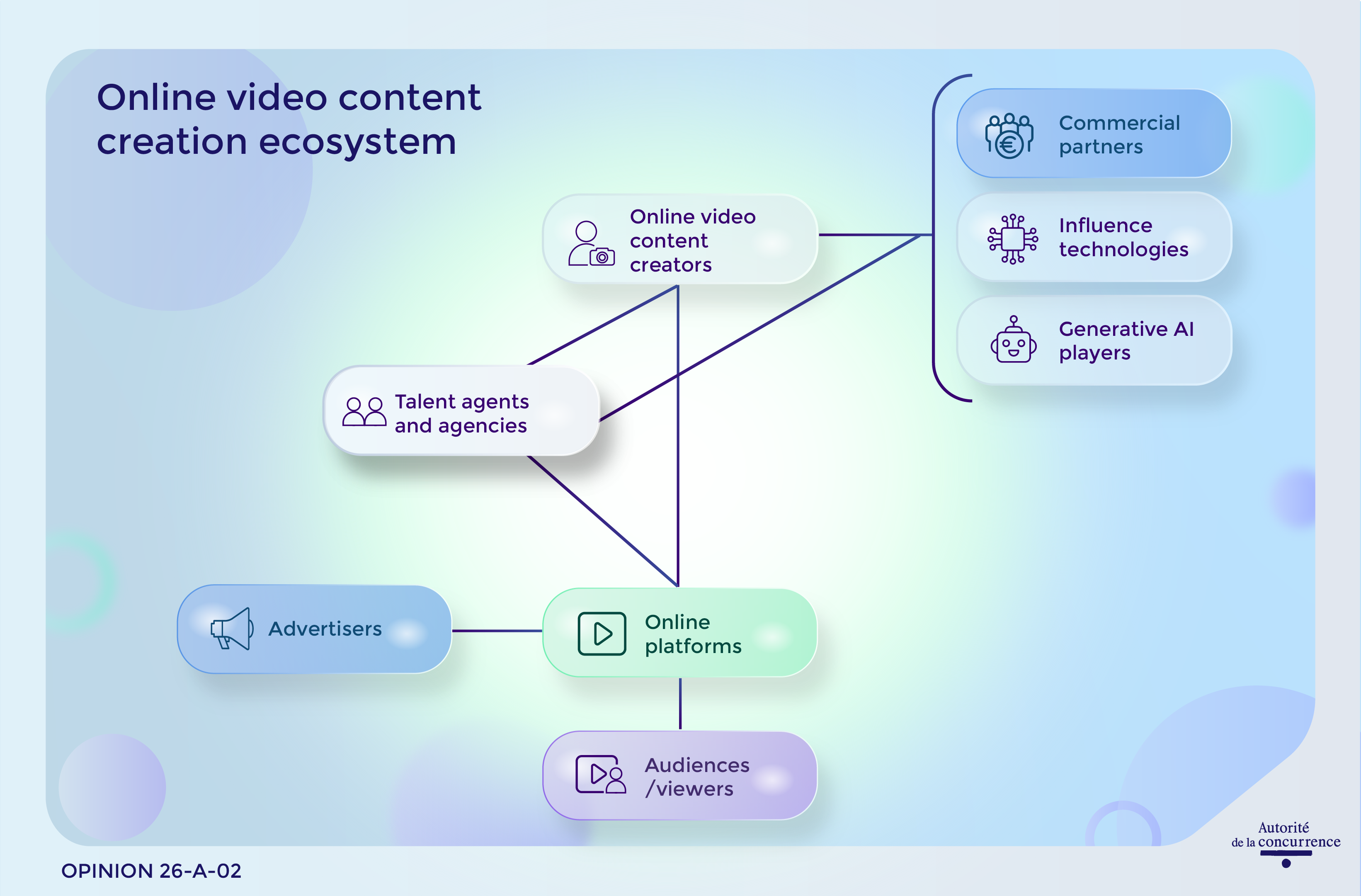
In its opinion, the Autorité first examines competition between content creators in terms of both audience and advertisers. It also analyses the impact of generative AI on the sector. Lastly, from a competition law perspective, the Autorité examines the relationship between video content creators and the other players in the sector, including advertisers, talent agencies and platforms.
This press release focuses in particular on the relationship between content creators and platforms.
The relationship between content creators and platforms
Substantial market power of major platforms over content creators
In practice, online platforms compete to attract and retain content creators and, by extension, audiences, in order to generate revenue through various monetisation methods (advertising, donation commissions, paid subscriptions, etc.). In reality, the online video content creation sector is currently concentrated around a few key platforms, namely YouTube, TikTok, Instagram and, to a certain extent, Twitch.
The sector’s concentration and the existence of significant platform-side barriers to entry give platforms significant market power over content creators.
This market power is further strengthened by the fact that, from the perspective of content creators, substitutability between platforms presents significant constraints, due to their formats, preferred themes, specific cultures and expertise and, lastly, the imperfect overlap of their audiences. These constraints suggest the various platforms do not belong to the same product and service market.
From the perspective of content creators, the main platforms are more complementary than competing. This complementarity encourages multihoming (i.e. hosted by several platforms), a practice that allows creators to optimise and diversify both their audience and their revenues.
Structural dependence of content creators on platforms
Platforms are essential to content creators’ activity, and a small number of platforms often account for a very large share of their revenue. Conversely, a given content creator represents only a marginal share of a platform’s revenue, in particular if the creator has a moderate-sized audience.
The online video content creation sector is therefore marked by the structural dependence of content creators on platforms, which creates a significant imbalance between their respective bargaining powers.
Eighty per cent of the content creators who responded to the survey conducted by the Autorité confirmed their bargaining power with platforms is weak or very weak. During the hearings with the Board, even high-profile creators indicated there is a strong imbalance in favour of platforms.
Platforms unilaterally set the terms of their relations with creators
Unilateral setting of advertising revenue-sharing rules
The asymmetry in the bargaining power between content creators and platforms is particularly evident in platforms’ ability to unilaterally set the terms for sharing revenues from the sale of online advertising space, in terms of both the existence of such sharing and the associated rules and the implementation of the mechanism.
The existence of revenue-sharing mechanisms at platforms’ discretion
Unlike related rights, for example, the law does not require platforms to propose any sort of mechanism for sharing revenue with content creators. As a result, given the significant asymmetry in the bargaining power between content creators and platforms, the existence of such mechanisms is at the sole discretion of platforms. The Autorité notes, for example, that Instagram has not introduced an advertising revenue-sharing mechanism.
Revenue-sharing rules imposed, with no possibility to negotiate individual terms
For platforms with a revenue-sharing mechanism (YouTube, TikTok, Twitch, etc.), access to such mechanisms is generally subject to minimum audience (number of subscribers and/or views) or activity (volume of content) thresholds, which de facto excludes a portion of video content creators in France, despite such creators also generating revenue for the platforms.
Furthermore, content creators have very limited, or even no, individual bargaining power over the monetisation of their content, preventing them from obtaining individual terms, especially since platforms’ commercial policy decisions are made outside France.
Opaque implementation procedures
In addition, the Autorité stresses that platforms have sole control over the implementation of revenue-sharing rules and that content creators have minimal access to the underlying data, including, for example, how content views are counted or the definition of the advertising revenue base. As a result, many content creators complain of a lack of visibility regarding future revenues.
Unilateral setting of content visibility terms
Opaque recommendation algorithms and moderation measures
The visibility of content on platforms is a crucial parameter in content creators’ activity, determining their ability to reach and retain audiences and thus generate revenue. This visibility is primarily determined by recommendation algorithms and, to a lesser extent, moderation measures, both of which are fully under platforms’ control.
As a result, creators have no real control over how their content is distributed or promoted.
The Autorité regrets the lack of transparency and calls on platforms to be more transparent in the implementation of their recommendation algorithms and moderation measures.
The Autorité also urges platforms to mobilise sufficient human and material resources so that creators, whatever their profile, can reach platform representatives capable of explaining, for instance, a drop in content visibility, a moderation action sanctioning their content or a ban.
Competition risks associated with recommendation algorithms
Platforms can leverage their control over their algorithms and moderation measures to maximise profitability, potentially undermining fair competition between content.
Consequently, the Autorité reminds platforms that unfair implementation of algorithmic recommendation rules or moderation measures may raise serious competition concerns under Articles 102 TFEU and L. 420-2 of the French Commercial Code (Code de commerce).
For example, the following behaviours could be considered problematic:
- if a platform gives less prominence to content featuring a commercial partnership between a creator and an advertiser, in order to encourage the advertiser to maximise its spending on online advertising space to the detriment of partnerships with creators;
- if a platform seeks to promote the visibility of certain content that is especially lucrative or otherwise beneficial for them – and, potentially in the longer term, content entirely created in‑house by generative AI.
Summary of the recommendations
- Given the asymmetry in the bargaining power between commercial partners and most content creators, the Autorité encourages creators to assert their rights under the applicable legal framework in their commercial relations with their partners. To this end, it urges professional organisations, such as the French Union of Influencers and Content Creators (UMICC), to continue their work in training creators and providing useful resources (contract templates, factsheets, etc.) (recommendation 1).
- Insofar as the fact that video content has, or has not, been created by generative AI may constitute a parameter of competition between different content, operators of generative AI systems and online platforms must ensure that content created by generative AI can be clearly identified (recommendation 2).
- Insofar as the terms governing revenue sharing between content creators and platforms are set unilaterally by platforms, the Autorité calls on platforms to ensure that such terms – and their implementation – are fair. In this respect, the Autorité urges platforms to increase transparency in the implementation of revenue-sharing rules (recommendation 3).
- Given the importance of content visibility for creators’ activity, the Autorité recommends that platforms demonstrate greater transparency in the implementation of their recommendation algorithms, so that creators can better understand and predict the visibility of their content on platforms. This transparency should also extend to changes and updates in the functioning of algorithms (recommendation 4). The Autorité also calls for platforms to exercise vigilance in ensuring transparency in the moderation of hosted content (recommendation 5). For the same reason, the Autorité urges platforms to mobilise sufficient human and material resources so that creators, whatever their profile, can reach platform representatives capable of explaining a drop in content visibility or a moderation action sanctioning their content (recommendation 6).
- In the absence of negotiations on the terms of content visibility, the Autorité reminds platforms that unfair implementation of algorithmic recommendation rules or moderation measures may raise serious competition concerns under Articles 102 TFEU and L. 420-2 of the French Commercial Code. In particular, any strategy whereby platforms seek to promote the visibility of certain content that is especially lucrative or otherwise beneficial for them – and, potentially in the longer term, content entirely generated in-house by generative AI – could disrupt competition between content and be highly detrimental to the diversity of supply for consumers (recommendation 7).
Opinion 26-A-02 of 18 February 2026
Contact(s)