Background
The Autorité de la concurrence has fined the French ski instructor union (Syndicat national des moniteurs du ski français – SNMSF) €3.4 million for imposing an exclusivity obligation on its member instructors, prohibiting them from exercising their profession outside ski schools run by École du ski français (ESF).
This obligation, which was particularly broad in scope, stemmed from an exclusivity clause added in 2006 to the standard agreement for ESF instructors. This clause prohibited member instructors from teaching skiing for a competing school or on an individual basis outside ESF ski schools. Such an infringement of the freedom of enterprise of instructors, who are self-employed, constitutes a generalised restriction of competition liable to foreclose the French national ski instruction market. As such, it constitutes an anticompetitive practice by object within the meaning of Article 101(1) of the Treaty on the Functioning of the European Union (TFEU) and Article L. 420-1 of the French Commercial Code (Code de commerce).
With the decision issued today, the Autorité reiterates that sporting activities are not exempt from the application of competition law, as the Court of Justice of the European Union (CJEU) confirmed in its judgments of 21 December 2023, Royal Antwerp Football Club (C-680/21), 21 December 2023, European Superleague Company (C-333/21) and 4 October 2024, FIFA v. BZ (C-650/22).
This decision also highlights the harmful effects of agreements designed to limit workers’ mobility and competition between the companies using their services. It therefore follows on from the decision issued by the Autorité in 2025 on no-poach practices in the engineering, technology consulting and IT services sectors (Decision 25-D-03 of 11 June 2025).
In addition, in accordance with the new provisions of Article L. 464-2 of the French Commercial Code, the Autorité has, for the first time, determined the amount of the fine in relation to the total worldwide turnover of all SNMSF member instructors active in the affected market, up to a limit of 10% thereof. Applying a provision of Title VI of the same article, the Autorité has also ordered the SNMSF – in the event the union is unable to pay all or part of the fine – to call for contributions from its members, in order to guarantee payment of the fine.
The SNMSF, a key player in ski instruction, present in almost all ski resorts and representing over 80% of ski instructors
France is Europe’s leading winter sports destination, with 250 ski resorts. Ski instruction is an important economic activity for many ski resorts and contributes to the vitality of the local economy. France has around 20,000 ski instructors, the vast majority of whom work for a ski school (SNMSF [ESF], SIMS [ESI], New Generation, CDA-Evolution 2, Oxygène 3 Vallées and Easyski) on a self-employed basis.
The SNMSF is the leading professional downhill ski instructor union in France, overseeing its instructors’ activity within local ESF ski schools. A long-standing player in the sector, it boasts an extremely dense network: ESF ski schools are present in almost all French resorts (216 out of 250) and have over 16,000 ski instructors, representing around 80% of all instructors working in France.
In the second half of 2025, the Economic Affairs Committee of the French National Assembly (Assemblée nationale) conducted a “flash mission” on unfair competition in the ski economy. The conclusions of the mission provide insight into the context in which SNMSF’s practices took place. The considerable influence of the SNMSF and ESF ski schools in the local and national tourism ecosystem, linked to their long-standing presence in ski resorts, has been a source of concern among several operators in the sector.
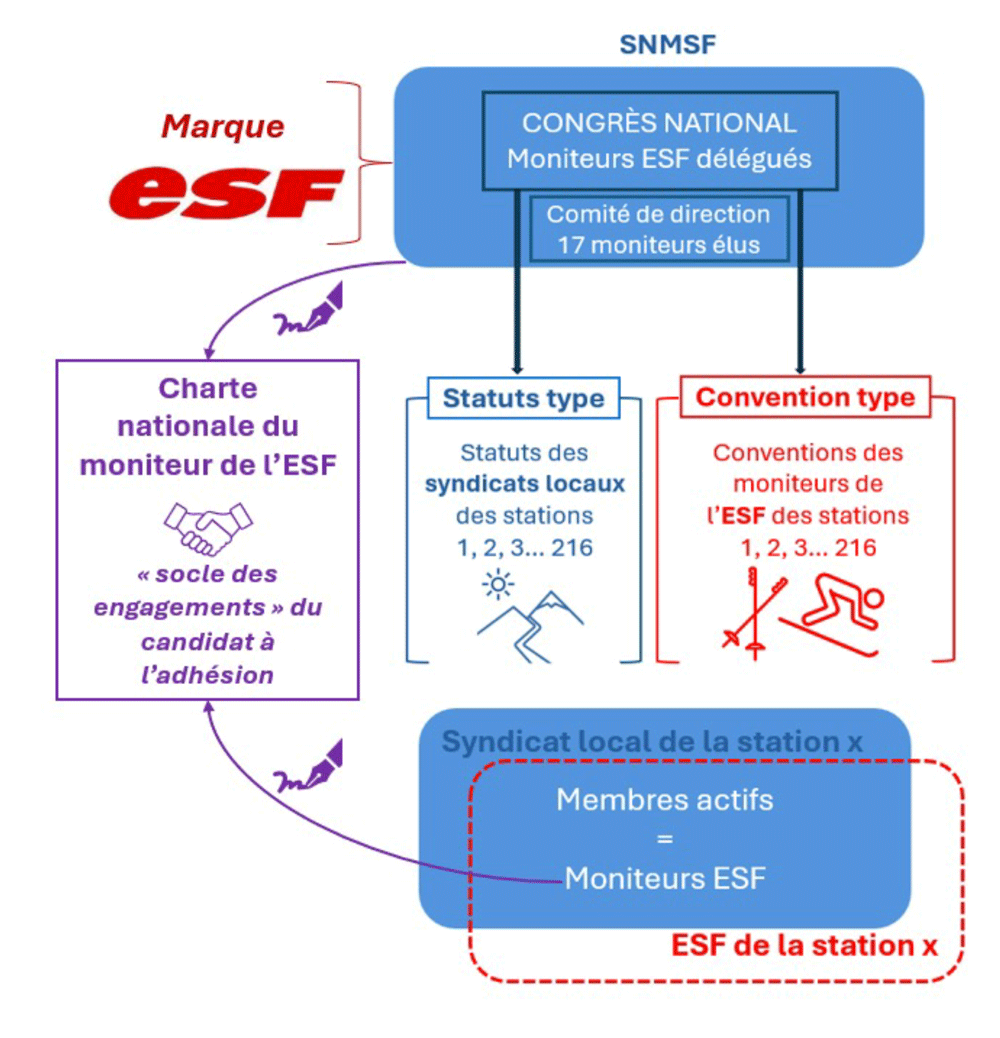
The SNMSF’s main decision-making body is the national congress, which represents all member instructors through their delegates. In particular, the national congress draws up a standard agreement setting out the operating and management rules for member instructors; all ESF ski schools then incorporate these rules into their local agreement, which is signed by each instructor.
The following diagram summarises the organisation of the ESF and the leading role of the SNMSF:
The introduction of an exclusivity obligation prohibiting SNMSF member instructors from working outside ESF ski schools, thereby foreclosing the ski instruction market
-
The introduction of a particularly strict exclusivity obligation
In 2006, the SNMSF national congress adopted a motion inserting a clause into the standard agreement, prohibiting instructors “from teaching in a competing individual or group structure”. Only mobility between ESF ski schools was authorised, “subject to the agreement of the director of the ESF ski school of origin”. Instructors were not permitted to develop a personal clientele outside an ESF ski school or within a competing ski school.
In 2013, the SNMSF national congress reinforced this exclusivity obligation in several respects:
- the sanction for non-compliance was made more severe by the introduction of automatic exclusion from the SNMSF and ESF;
- a general ban on membership of any union other than the SNMSF was introduced, despite several competing ski schools being organised in this way;
- a specific suspension penalty was introduced for failure to comply with the obligation to forward all fees received by instructors to the ESF.
The Autorité considers the exclusivity obligation to be particularly broad in scope, since it applies to all member instructors, regardless of their status (member, non-member, trainee), the type of instruction (e.g. downhill skiing, snowboarding, telemark skiing), the lesson format (individual or group) and the level of activity of the ESF ski school, and throughout the SNMSF membership year (not just the ski season).
Such an obligation seems particularly stringent as its scope far exceeds the exclusivity provisions of competing ski schools. In addition, the risk of exclusion in the event of non-compliance with this obligation is likely to ensure adherence by instructors, as shown by the average length of uninterrupted SNMSF instructor membership, which is around 19 years, rising from 17 years in 2014 to 21 years in 2024. In general, instructors in competing ski schools are only committed to those schools for the instruction period for which they have signed up.
The result is a generalised restriction on instructor mobility.
-
Market foreclosure reinforced by ESF’s structural advantages
In addition, the exclusivity obligation applies in a context that accentuates its scope. Since ski instructors are an essential resource for ski schools, competition between schools depends crucially on their ability to recruit sufficient qualified instructors. On this point, the SNMSF’s competitor ski schools told the Autorité they were struggling to expand, mainly due to the SNMSF’s dominant position, but also as a result of the high barriers to market entry. They face major difficulties in recruiting the resources they need to develop their business.
While, to ensure the smooth running of ESF ski schools, the SNMSF is generally free to adopt rules governing the activities of ski instructors, thereby limiting their freedom to work, such rules cannot legitimise a system which, as in the present case, leads to a generalised restriction of competition liable to foreclose the French national ski instruction market.
In the absence of evidence justifying an exemption, the exclusivity obligation in questions constitutes a restriction of competition in breach of French and European law applicable to anticompetitive agreements.
The Autorité imposes a fine of €3,400,000 on the SNMSF, applying the new sanctions system for professional associations for the first time (Article L. 464-2 of the French Commercial Code)
The Autorité has imposed a fine of €3.4 million on the SNMSF. It has also ordered the SNMSF to publish a summary of the decision on its website and in the specialised and regional press, to communicate this summary by email to member instructors and to amend the standard agreement and any other documents required for its application, in order to comply with competition law.
In the decision issued today, the Autorité has applied the new provisions of Article L. 464-2 of the French Commercial Code. Under these provisions, when the practice implemented relates to their activity, the fine imposed on an association of undertakings can be determined by taking into account the turnover generated by all its members active in the market affected by the infringement.
For the first time, this decision implements Title VI of Article L. 464-2 of the French Commercial Code, enabling the Autorité to order the SNMSF – in the event the union is unable to pay all or part of the fine – to call for contributions from its member instructors. In addition, the Autorité has ordered the SNMSF to publish a summary of the decision on its website and in the newspapers L’Equipe and Le Dauphiné Libéré and to communicate this summary by email to member instructors.
Decision 26-D-03 of 17 March 2026
Contact(s)