The Autorité de la concurrence fines the Syndicat national des distributeurs spécialisés de produits biologiques, Greenweez (Carrefour), ITM Entreprises and Les Comptoirs de la Bio (Les Mousquetaires group) €12.67 million for a brand allocation agreement

Background
The Autorité de la concurrence has fined the French organic distributors trade association (Syndicat national des distributeurs spécialisés de produits biologiques; hereinafter “Synadis Bio”), Greenweez, Les Comptoirs de la Bio (hereinafter “LCB”) and ITM Entreprises (hereinafter “ITME”) for taking part in a single, complex and continuous agreement aimed at allocating organic suppliers’ brands between specialist stores (known in France as “grandes surfaces spécialisées” or “GSS”) and generalist supermarkets (known in France as “grandes surfaces alimentaires” or “GSA”).
Through meetings of its Board of Directors, followed by internal rules adopted in 2018, Synadis Bio implemented a collective strategy aimed at preventing the sale of the same organic brands within GSS and GSA distribution channels, in order to avoid comparability of products and prices between the two channels, which could have led to an across-the-board drop in prices to the detriment of GSS operators.
The agreement lasted for more than seven years and took place against a backdrop of strong growth in the supply of organic products in the GSA channel, which had become the leading distribution channel for such products since 2016.
In addition to the trade association, the Autorité found that Greenweez, Les Comptoirs de la Bio and ITM Entreprises were also actively involved in the practices.
Consequently, the Autorité has imposed a total fine of €12,670,000, broken down as follows:
- €10 million for Synadis Bio;
- €1.85 million for Greenweez (jointly and severally with its parent company Carrefour SA);
- €740,000 for ITM Entreprises (jointly and severally with its parent company Les Mousquetaires); and
- €80,000 for Les Comptoirs de la Bio.
This is the second time the Autorité has applied the new provisions of Article L. 464-2 of the French Commercial Code (Code de commerce), under which it can now determine the amount of the fine imposed on an association of undertakings in relation to the total worldwide turnover of all its members active in the market affected by the infringement, up to a limit of 10% thereof.
An agreement implemented in response to the growing position of GSA in the distribution of organic products
Between 2010 and 2020, organic food consumption in France quadrupled, rising from €3.7 billion in 2010 to €6.7 billion in 2015 and €13.2 billion in 2020.
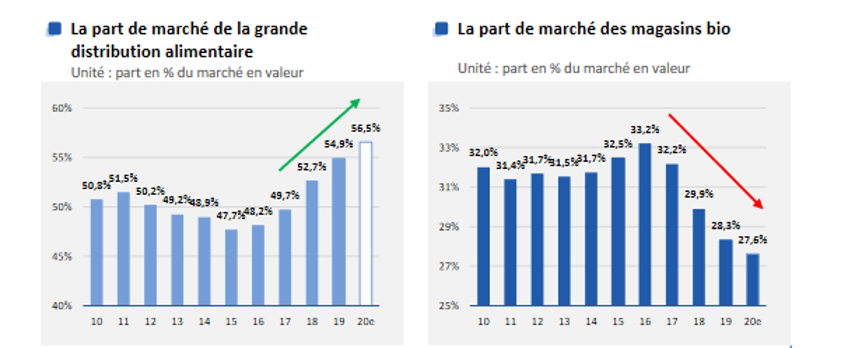
Between 2016 and 2020, conventional supermarkets (known in France as “grandes surfaces alimentaires” or “GSA”) strengthened their position in the organic market, to the detriment of specialist stores (known in France as “grandes surfaces spécialisées” or “GSS”). GSS market share remained steady at around 32% to 33% until 2016/2017 but fell sharply from 2018, dropping below 28% by 2020. Conversely, GSA market share grew steadily over the period, exceeding 56% in 2020.
Source: Xerfi
The convergence of generalist and specialist food retailers
2012 saw the first type of convergence of GSA and GSS, with the creation of organic store formats backed by their respective generalist retailers. The formats were soon abandoned, however, with GSA turning their strategy to the acquisition of GSS.
For example, Carrefour acquired online organic store Greenweez in 2016, followed by specialist banners So.Bio in 2019 and Bio c’Bon in 2020. Carrefour Bio outlets then became part of the specialist distribution network.
Similarly, the Les Mousquetaires group (hereinafter “Intermarché” or “ITM”) – which had not developed its own organic store format – gradually acquired a stake in Les Comptoirs de la Bio (hereinafter “LCB”) from 2018.
The introduction by Synadis Bio of an agreement aimed at allocating organic suppliers’ brands between generalist and specialist distribution channels
-
Synadis Bio took action to segregate distribution channels by brand
Between 2016 and 2020, competition between GSA and GSS increased considerably. The share of sales generated by GSA rose significantly, to the detriment of GSS, notably due to the growth of organic products sold under own brands.
In this context, discussions within the trade association began in 2016, aimed at strengthening brand differentiation between distribution channels (in order to prevent price comparability for the same brand across the two distribution channels) and maintaining a higher price positioning in GSS.
The inclusion of a clause in Synadis Bio’s internal rules and the minutes of various meetings of its Board of Directors attest to the existence of the discussions, whether to share concerns regarding the development of Amazon Prime Now or to examine membership applications from banners backed by generalist food retail groups.
Minutes of 14 June 2017
The minutes of the meeting of the Board of Synadis Bio on 14 June 2017 mention concerns regarding Amazon Prime Now, which offers the sale and rapid delivery of organic products, in particular from the Bio c’Bon product range, in an environment combining organic and conventional products. According to the Board, the Amazon service was “a worrying new competitive development for specialist organic stores, as it blurs the boundaries between distribution channels and promotes price comparability”, and entailed “a clear loss of differentiation” in specialist organic stores’ offerings that was likely to generate price pressures. In addition, the Board questioned the position of suppliers regarding the sale of their organic products on Amazon alongside conventional brands.
Minutes of 6 June 2018
On 6 June 2018, the Board discussed Les Comptoirs de la Bio’s continued membership of Synadis Bio in 2018, as well as ITM’s commitment to maintaining a strict separation between the specialist and generalist distribution networks, excluding any permeability of ranges, any coexistence of brands between the two distribution channels and any own brand references, in order to avoid any “mixing of categories”.
During the discussions, Synadis Bio explicitly expressed its desire to differentiate brands according to distribution channel, in order to avoid comparability of products and therefore prices. Asked by an ITME representative during the review of ITME’s membership application, “what do you, specialist organic stores, expect from us?”, Synadis Bio answered, “quality, elevating organic products to higher standards, not lowering. Not undercutting prices”.
Minutes of 22 March 2019
So.Bio’s membership application, initially accepted at the Board meeting on 12 September 2018, was called into question in the light of information on the development strategy of the network, which was now part of the Carrefour group, based on rapid growth ambitions and a stated policy of “low cost” pricing (“prices 30% lower than the historic specialist network”), a strategy deemed incompatible with the trade association’s positioning and values.
Adoption of new internal rules (13 December 2018)
In December 2018, Synadis Bio decided to include the principle of brand segmentation by distribution channel in its internal rules. In particular, Article 2 requires its members to “stock at least 95% packaged organic food products, distributed exclusively in specialist organic stores”.
The trade association’s members therefore collectively decided to prohibit the distribution in their stores of products that would be sold in GSA and, inversely, to prevent the brands distributed in GSS from being sold in generalist food retail channels.
-
Greenweez, Les Comptoirs de la Bio and ITM Entreprises each played an active role in the agreement
The evidence collected during the investigation also showed that Greenweez and Les Comptoirs de la Bio actively participated in the agreement, notably during the interviews held when their applications to join Synadis Bio were examined. The companies affirmed their commitment to adhere to the “standards and practices of the organic sector”, thus agreeing to uphold the agreement implemented within the trade association.
Greenweez confirmed to Synadis Bio its commitment to ensure that “there is absolutely no mixing of brands and ranges” and to adhere to the GSS model by aligning with their “unwritten rules”. The Greenweez representative stressed store managers’ commitment not to “undermine the specialist organic market” and to adapt “their selling prices to those of surrounding organic stores”.
Similarly, on 6 June 2018, representatives of Les Comptoirs de la Bio and ITME (LCB shareholder) discussed the question of Les Comptoirs de la Bio’s continued membership of Synadis Bio. The discussions covered ITM’s commitment to maintaining a strict separation between the specialist and generalist networks, excluding any permeability of ranges, any coexistence of brands between the two distribution channels and any own brand references, in order to avoid any “mixing of categories”. The ITME representative also stressed ITM’s commitment not to “undercut prices” and to adhere to the standards and values of specialist organic distribution.
Total fine of €12,670,000 imposed by the Autorité on Synadis Bio, Greenweez, ITM Entreprises and Les Comptoirs de la Bio and application of Article L. 464-2 of the French Commercial Code
By asking its members to align their commercial policy on a parameter relating to free competition, Synadis Bio intervened in the market beyond its mission of defending the interests of the profession.
The Autorité considers such practice to be serious, insofar as it has unquestionably limited intra-brand, inter-brand and price competition between the two distribution channels.
The total amount of the fine imposed is €12,670,000, broken down as follows:
- Synadis Bio: €10 million;
- Greenweez (jointly and severally with its parent company Carrefour SA): €1.85 million;
- ITM Entreprises (jointly and severally with its parent company Les Mousquetaires): €740,000;
- Les Comptoirs de la Bio: €80,000.
The Autorité has also ordered the trade association to amend the disputed provisions of its internal rules and to publish a summary of the decision in a trade journal.
This is the second time[1] the Autorité has applied the new provisions of Article L. 464-2 of the French Commercial Code (Code de commerce), under which it can now determine the amount of the fine imposed on an association of undertakings by taking into account the turnover generated by all its members active in the market affected by the infringement.
[1] On 17 March 2026, the Autorité de la concurrence fined the SNMSF €3.4 million for imposing an exclusivity obligation on its member instructors, prohibiting them from exercising their profession outside ESF ski schools.
Decision 26-D-05 of 16 April 2026
Contact(s)