Cinema and audiovisual: the Autorité issues an opinion on competition in the talent representation sector

Background
Considering that economic violence fell within the substantive scope of its work, the commission of inquiry of the French National Assembly (Assemblée nationale) into violence in the film, audiovisual, live performance, fashion and advertising sectors asked the Autorité de la concurrence for an opinion. Further to this request, the Autorité has issued an opinion analysing the competitive functioning of the talent representation sector in the film and audiovisual industry and setting out several recommendations aimed at addressing the negative consequences of market concentration in this sector. This is the first time that an administrative authority has examined the sector in such depth.
How the sector works
Talent representation involves representing artists and defending their professional interests in dealings with other sector operators, in particular producers, with a view to securing roles for artists in artistic projects, negotiating the terms of their employment contracts, and thereby developing their professional careers.
Talent agents enter into agency agreements with artists, often on a merely verbal basis. In addition, the relationship between agent and artist is very often based on the principle of exclusivity. Certain aspects of talent agents’ remuneration are regulated by the French Labour Code (Code du travail); in particular, their commission has been capped, since 1971, at 10% of artists’ gross remuneration. In practice, this commission is paid directly by producers to agents, meaning that artists may not necessarily be fully aware of the fact it is deducted from their remuneration. Moreover, it appears that most operators ultimately view this commission rate as both a maximum and a minimum and are unaware that it can be negotiated downwards.
The Autorité, which heard from a number of artists during the preparation of this opinion – including Guillaume Gallienne and Denis Podalydès – found that agents play a key role in the sector, ensuring that artists are visible to producers and facilitating contacts during auditions. Furthermore, the sector is highly dependent on the dynamism of the French film and audiovisual industry, which is increasingly favouring big-budget productions.
The structure and competitive dynamics of the sector
The sector is highly concentrated around two major agencies: the Adéquat/Artmedia group and, to a lesser extent, the UBBA agency. Their prominent position in the sector is reflected both in their economic weight and in their presence in French productions.
This concentration has several negative consequences for the film and audiovisual industry, as it creates bottlenecks in the casting process and may affect the quality of services provided to artists and increase the risk of conflicts of interest.
Recommendations to improve the functioning of the sector
To mitigate the negative effects arising from this level of concentration, the Autorité analysed a number of measures. First, with regard to the proposals put forward by the commission of inquiry, such as introducing professional certification or increasing agents’ training requirements, the Autorité considers that such measures would not help to alleviate the sector’s high level of concentration. However, it supports wider adoption of the various mechanisms that facilitate direct contact between artists and producers.
In addition, the Autorité examined the structure of agents’ remuneration. While it does not recommend removing the cap on commissions, given the uncertainty surrounding the overall effects of such removal, it recommends updating the level of the cap, which has remained unchanged since 1971. It also recommends providing artists with better information about the possibility of setting a commission rate below 10%. Lastly, the Autorité emphasises the need to improve the information provided to artists on the terms of agency contracts, in particular the services to be provided, in order to promote competition in the sector. In this regard, it invites agents to adopt written agency contracts as standard practice.
How the talent representation sector works
-
The role of the talent agent
The role of the talent agent is defined in Article L. 7121-9 of the French Labour Code as consisting of “receiving a mandate, in return for payment, from one or more performing artists for the purpose of securing work for those artists and representing their professional interests”.
Agents therefore play a role in developing artists’ professional careers (seeking artistic projects, establishing contact with sector operators), providing support (maintaining artists’ visibility among sector operators, advising artists on artistic choices), and negotiating artists’ employment contracts with producers.
The nature of an agent’s role depends primarily on the level of experience and reputation of the artist represented. For artists whose careers are still developing, agents focus on finding artistic projects, whereas for more established artists, their role is more focused on ensuring continuity in their professional careers.
Access to the profession has changed significantly in recent years. Until 2010, talent agents were required to hold a licence to practise, but several legislative changes have since substantially expanded access to the profession. The national register maintained by the French Ministry of Culture was abolished in 2016.
-
Contractual relationship between agents and artists
Artists enter into agency contracts with their agents, which are most often verbal and based on a principle of exclusivity. In practice, however, this exclusivity is largely theoretical, as an artist may terminate their agency contract with their agent at any time, whether the contract is written or verbal.
Talent agents’ remuneration is governed by the French Labour Code, which has, since 1971, capped their commission at 10% of their artists’ gross remuneration, whether fixed or linked to the revenue generated by their work or performances. The Autorité found that, in practice, producers pay agents directly on behalf of artists. As a result, the payment of this commission is not always visible to artists, who may not be aware of the amount or the fact it is actually deducted from their remuneration.
-
Talent agents as a key interface in the sector
Talent agents work with all operators in the sector, maintaining close relationships with producers responsible for recruiting artists, as well as with casting directors. Both producers and casting directors emphasise the importance of agents’ work in ensuring artists’ visibility and facilitating contact and dialogue during casting processes.
-
The economic environment in the film and audiovisual industry affects talent agents’ work
Talent agents’ work depends largely on the dynamism of the film and audiovisual industry and, in particular, on the financing of productions. In France, this financing model is based on the principle that downstream operators (broadcasters and distributors) finance upstream operators (producers). Since 2021, the inclusion of foreign on-demand audiovisual media services, such as Netflix, Disney+ and Amazon Prime Video, in the French financing system has increased the proportion of big-budget productions in the French film and audiovisual ecosystem, to the detriment of lower-budget productions. This trend has been intensified by an overall decline in funding, which has led to resources being increasingly concentrated on big-budget productions. This economic climate benefits the largest talent agencies, as major productions tend to turn to agencies with the largest and most sought-after talent rosters.
The structure and competitive dynamics of the sector
-
A sector dominated by two agencies
The talent representation sector is highly concentrated around two major agencies: the Adéquat/Artmedia group and, to a lesser extent, the UBBA agency. While there a number of small and mid-sized agencies in the sector, Adéquat/Artmedia and UBBA occupy a prominent position, both in terms of their economic weight and their presence in French productions.
This concentration has negative consequences for the sector as a whole. First, it creates bottlenecks in the casting process: as the two largest agencies handle the majority of enquiries, this can lengthen response times and delay the conclusion of contracts, potentially jeopardising certain projects and, in turn, increasing overall production costs. Moreover, this concentration may limit access to artists for less established directors and producers, as the leading agencies may be less inclined to respond to enquiries from less well-known operators. Lastly, some of the operators consulted consider that certain agencies’ prominent position may give rise to conflicts of interest, as the largest agencies may be more inclined to prioritise certain clients over others.
-
Strong network effects
The talent representation sector is a two-sided market in which agents act as intermediaries between artists and producers. The more artists an agency represents, particularly high-profile artists, the more attractive that agency becomes to other artists. The same dynamic applies to producers. At the same time, producers tend to favour agencies representing a large number of artists or highly sought-after talent. As a result, larger agencies attract more artists and producers, further strengthening their appeal and position as key players in the sector.
Accordingly, achieving critical mass is a major challenge for agencies, and it is difficult for new entrants or small agencies to expand in the face of established operators. These network effects therefore create barriers to entry and expansion.
-
Other economic characteristics of the sector that reinforce concentration
Information asymmetries
The Autorité noted the existence of information asymmetries regarding casting opportunities. Combined with the principle of agents’ exclusive representation, artists are further inclined to turn to the largest agencies, which have extensive networks of producers, in order to maximise their opportunities to secure roles.
The importance of cost control
Faced with declining budgets for casting and high matching costs, due to the large number of actors on the market, producers are increasingly inclined to turn to larger agencies with extensive talent rosters, in order to control their costs and maximise their chances of finding the ideal profile.
Significant movement of artists towards larger agencies
Moreover, the Autorité found that artists frequently move to larger agencies once they have established a degree of recognition. This trend benefits these larger agencies, which are able to take on these artists without having borne the significant costs involved in developing their careers.
Lastly, the Autorité identified several economic factors, such as the increase in the number of big-budget productions and the growing complexity of agency contracts, which are driving the trend towards concentration in the sector.
The recommendations made by the Autorité de la concurrence
-
The proposals put forward by the commission of inquiry
First, the Autorité examined the measures proposed by the commission of inquiry in its request for an opinion. With regard to the introduction of professional certification and an increase in agents’ training requirements, the Autorité considers that while such measures would further professionalise the role of talent agent, they would not help to alleviate the sector’s high level of concentration and the resulting negative consequences.
The commission of inquiry also proposes adopting measures to facilitate actors’ direct access to productions, and vice versa. The Autorité notes that mechanisms, such as open castings, already exist to facilitate direct contact between artists and producers or casting directors, and recommends introducing incentives to encourage wider take-up, such as making some funding conditional on their adoption.
-
The structure of talent agents’ remuneration
Insofar as the structure of agents’ remuneration may explain certain characteristics of the sector, the Autorité paid particular attention to this issue, examining potential adjustments that could be made to mitigate the negative effects of the sector’s high level of concentration.
As the Autorité has noted on several occasions, price caps should not, in principle, be regarded as a standard tool in a market economy, as they may produce unintended effects without necessarily generating any benefits for consumers. In particular, they tend to become focal points, i.e. price points towards which operators converge. This appears to be the case here, as the commission rates observed between agents and their artists appear to be largely aligned with the 10% cap.
Despite the potential adverse effects of price caps, the Autorité has acknowledged that such measures may be justified, in particular to protect captive and vulnerable consumers. In this case, the parliamentary debates leading to the adoption of the French law of 26 December 1969 show the cap on agents’ commissions introduced at the time was intended to address abuses that had been observed to the detriment of artists who were in a weak position vis-à-vis their agents. Given the sector’s current high level of concentration, there is no guarantee that similar abuses would not recur if the cap were removed.
Moreover, the Autorité notes the overall effects of removing the cap on talent agents’ commission on the concentration of the sector are uncertain. Removing the cap could lead to higher commission, particularly benefiting the largest agencies.
On the other hand, certain measures, such as updating the level of the cap and informing stakeholders that commission rates may be set below 10%, could help to mitigate some of the negative effects observed in the sector. In preparing its opinion, the Autorité did not identify the economic rationale for the rate being set at 10% in 1971 and found that it has never been revised since. Moreover, operators appear to widely perceive the 10% rate as a reference, even though it is merely a statutory cap that can be negotiated downwards.
-
Other recommendations
The Autorité recommends improving the information provided to artists on the terms of agency contracts. If artists had a better understanding of the services provided by their agents, their remuneration arrangements and the terms governing termination of their contracts, they would be better able to discuss these matters and assess the services actually provided by their agents. Better-informed artists would then be able to compare the services offered by competing agents, which could ultimately help to increase competition in the sector. In this regard, the Autorité invites agents to adopt written agency contracts as standard practice.
Lastly, in its opinion, the Autorité briefly outlines the applicable competition law framework, recalling that:
- it may use its ex post enforcement powers at any time in the event of anticompetitive practices, whether agreements or abuses of a dominant position; or
- it may also take action ex ante through merger control, in particular when reviewing potential mergers or other forms of consolidation between talent agencies.
Summary of the recommendations
- Recommendation 1: Given that various mechanisms currently exist to facilitate direct contact between artists and producers or casting directors, the Autorité recommends encouraging operators to make greater use of such mechanisms where appropriate.
- Recommendation 2: To mitigate some of the negative effects observed in the talent representation sector, the Autorité recommends updating the level of the cap, currently set at 10%, and informing stakeholders of the possibility of negotiating a commission rate below this cap.
- Recommendation 3: The Autorité recommends adopting measures to ensure that artists are better informed about the terms and execution of their agency contracts, in order to promote competition in the sector. In this regard, it invites agents, in particular, to adopt written agency contracts as standard practice, and to report periodically to artists on the performance of their duties.
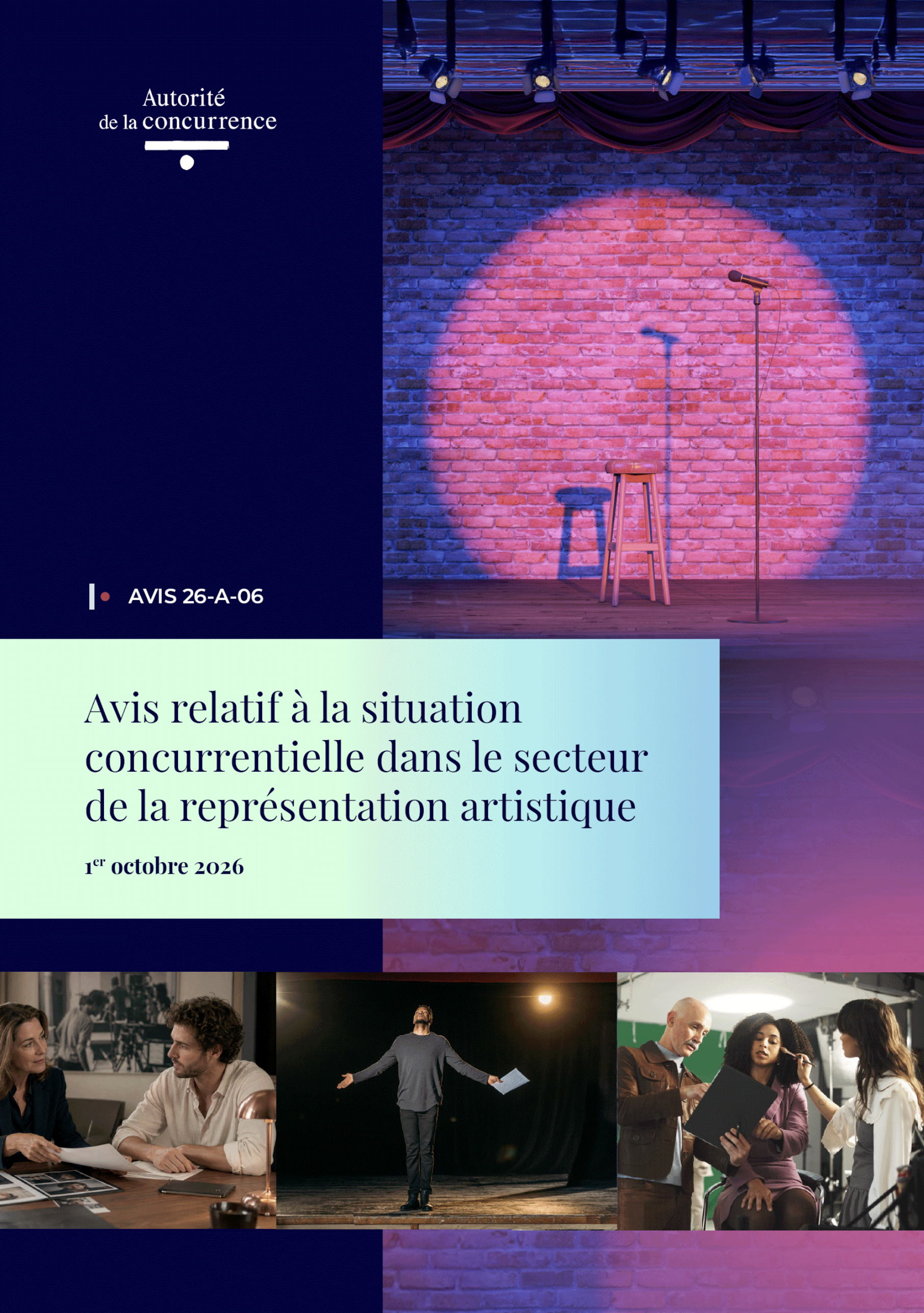
Opinion 26-A-06 of 1 October 2026
Contact(s)