
AI agents: the Autorité de la concurrence issues its opinion on the competitive functioning of the AI agents sector

Background
Following its analysis, in Opinion 23-A-08, of the competitive functioning of the cloud computing sector and then, in Opinion 24-A-05, of the competitive functioning of the generative artificial intelligence (AI) sector, and its study on the energy and environmental impact of AI, published in December 2025, the Autorité de la concurrence is deepening its analysis of AI by examining the competitive functioning of the AI agents (or agentic AI) sector. As part of its inquiries, the Autorité consulted a number of stakeholders and institutional representatives across the sector and received around 40 contributions to its public consultation.
Initially designed as simple conversational agents, AI tools have gradually evolved into agents capable of reasoning, planning and orchestrating multiple tasks by coordinating with other AI agents. In a dynamic sector characterised by the presence of numerous AI agent developers, only a handful of operators account for the vast majority of users, with OpenAI, Google and Anthropic together holding more than 84% of the market.
This opinion also examines agentic commerce, one of the most recent use cases for AI agents, which applies their capabilities to the e-commerce sector. Although not yet available in France, agentic commerce could develop rapidly, as AI agents are already able to provide users with recommendations for products and services.
Barriers to entry and expansion
Barriers to entry are lower than for the training of generative models. However, AI agent developers’ ability to scale is significantly constrained by the need to reach users, as well as by numerous barriers to expansion (data access, technical migration, interoperability, inference costs, etc.).
Competition risks associated with AI agents as new intermediaries in the digital economy
By giving users access to an ever-expanding range of services and information through a single interface, AI agents are emerging as increasingly important gateways to digital services. The Autorité notes that the “platformisation” of AI agents raises competition risks (disintermediation, discrimination, visibility conditions, etc.) that could undermine the proper functioning of the sector and the diversity of services offered. These risks are amplified when AI agents are integrated into the existing services of companies that are already vertically integrated.
Risks associated with the automation of actions by AI agents
The implementation of the technical standards required for agentic AI may give rise to competition risks, particularly where their governance is centralised in the hands of a single operator or where barriers to interoperability emerge.
Given the potential of agentic AI to bring about significant disruption across the digital economy, the risks identified could materialise rapidly.
In the context of agentic commerce, this could result in the sector becoming concentrated around a small number of operators, purchasing processes becoming less transparent, and end consumers being deprived of the ability to make informed choices.
Outlook and recommendations
While it remains too early to establish definitive scenarios for the future trajectory of this rapidly evolving sector, which could reshape entire areas of the economy, the Autorité recommends close monitoring of these developments and, in particular, encourages:
- public authorities to fully implement the existing regulatory framework, including by ensuring that users can effectively compare offers and make informed choices;
- operators to promote interoperability and portability across the sector;
- operators to ensure the implementation of open standards.
The emergence of agentic AI
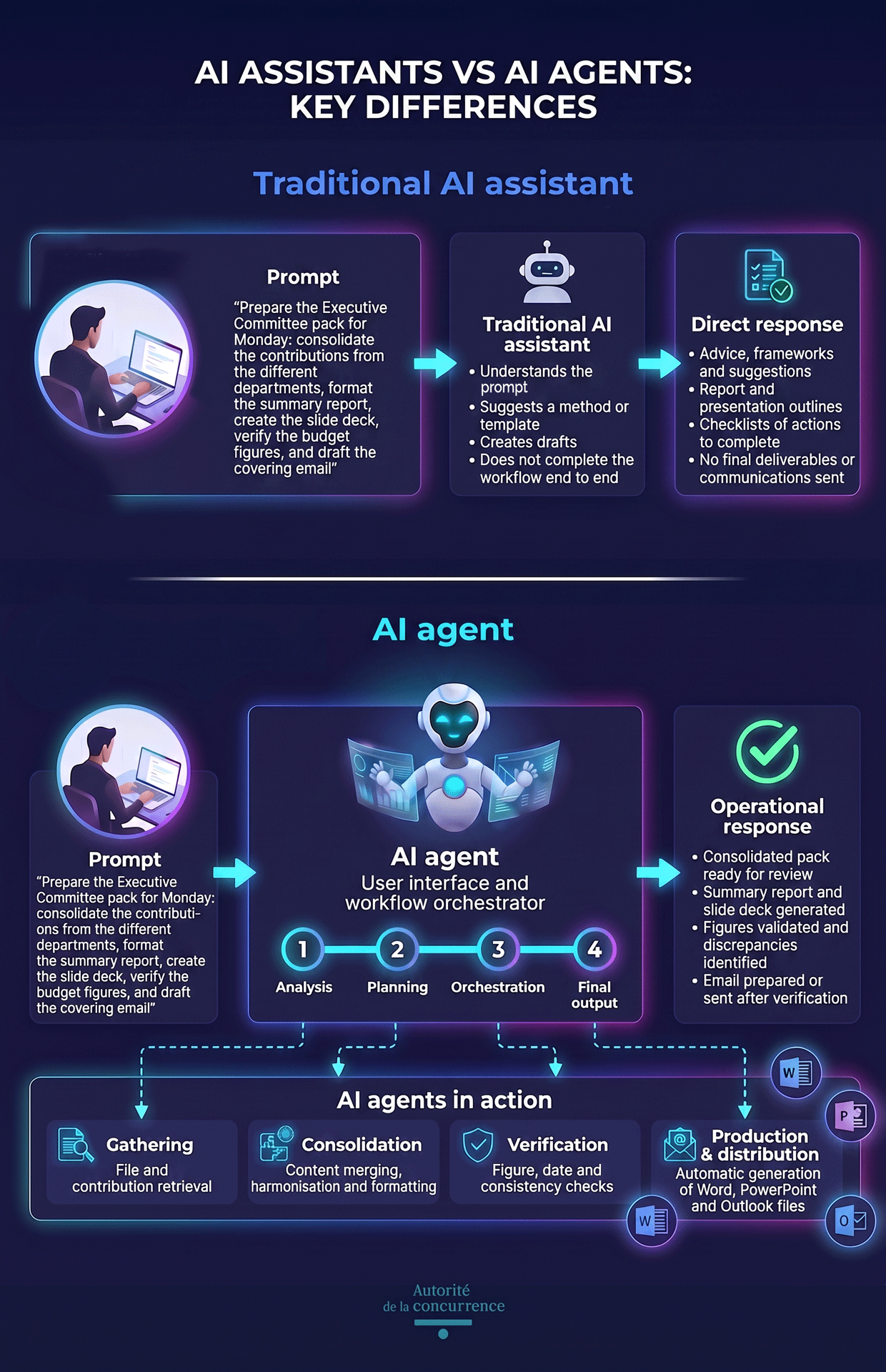
- From AI assistants to AI agents
Initially designed as simple conversational agents, also known as AI assistants or chatbots, generative AI tools have gradually evolved into AI agents. These agents no longer simply perform isolated tasks, but are now capable of reasoning, planning and orchestrating multiple tasks by coordinating with other AI agents with a degree of autonomy. The terms “agentic AI” and “AI agents” have been used to describe these new capabilities. According to the European Commission, AI agents are “software applications designed to perceive and interact with the virtual environment. [They] operate autonomously, meaning they are not directly controlled by a human”.
AI agents operate downstream in the generative AI value chain, during the deployment and marketing of generative AI services (the upstream segment of the value chain, particularly the resources required for training generative models, was analysed by the Autorité in Opinion 24-A-05). The use cases for AI agents are numerous: text generation (for example, emails, social media posts and user interactions), image creation or editing, and software code generation are just a few examples, already widely deployed across companies and public bodies.
The AI agents sector is highly concentrated around three main operators (OpenAI, Google and Anthropic), although other integrated operators (Amazon, Microsoft and Nvidia) and sector-native companies (Mistral AI, Perplexity AI and xAI) are also present. AI agents are offered either through a freemium model, with paid subscriptions providing access to advanced features, or on a pay-as-you-use basis.
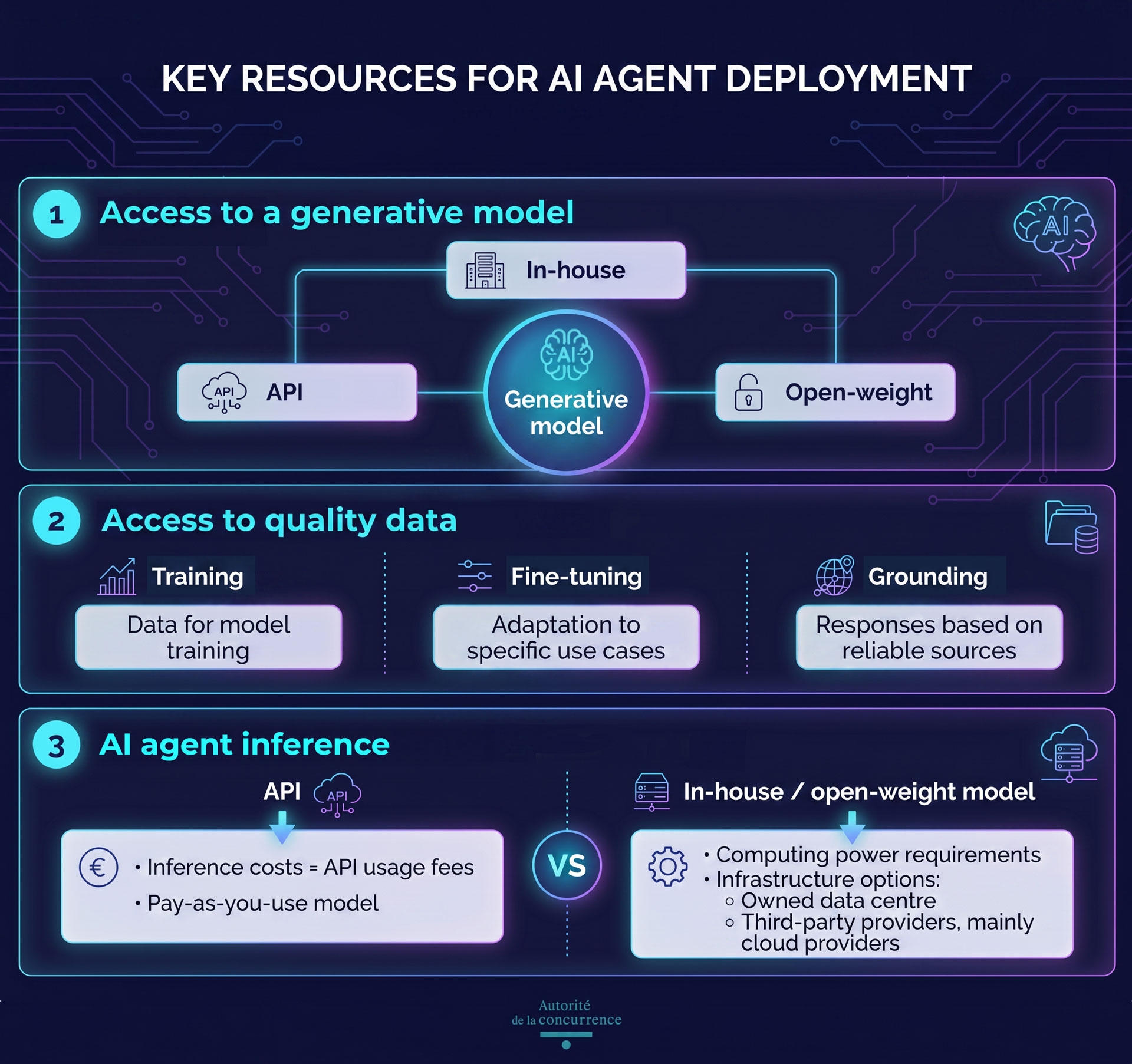
Making an AI agent available to users depends on three main resources: access to a generative model, access to quality data and inference capabilities.
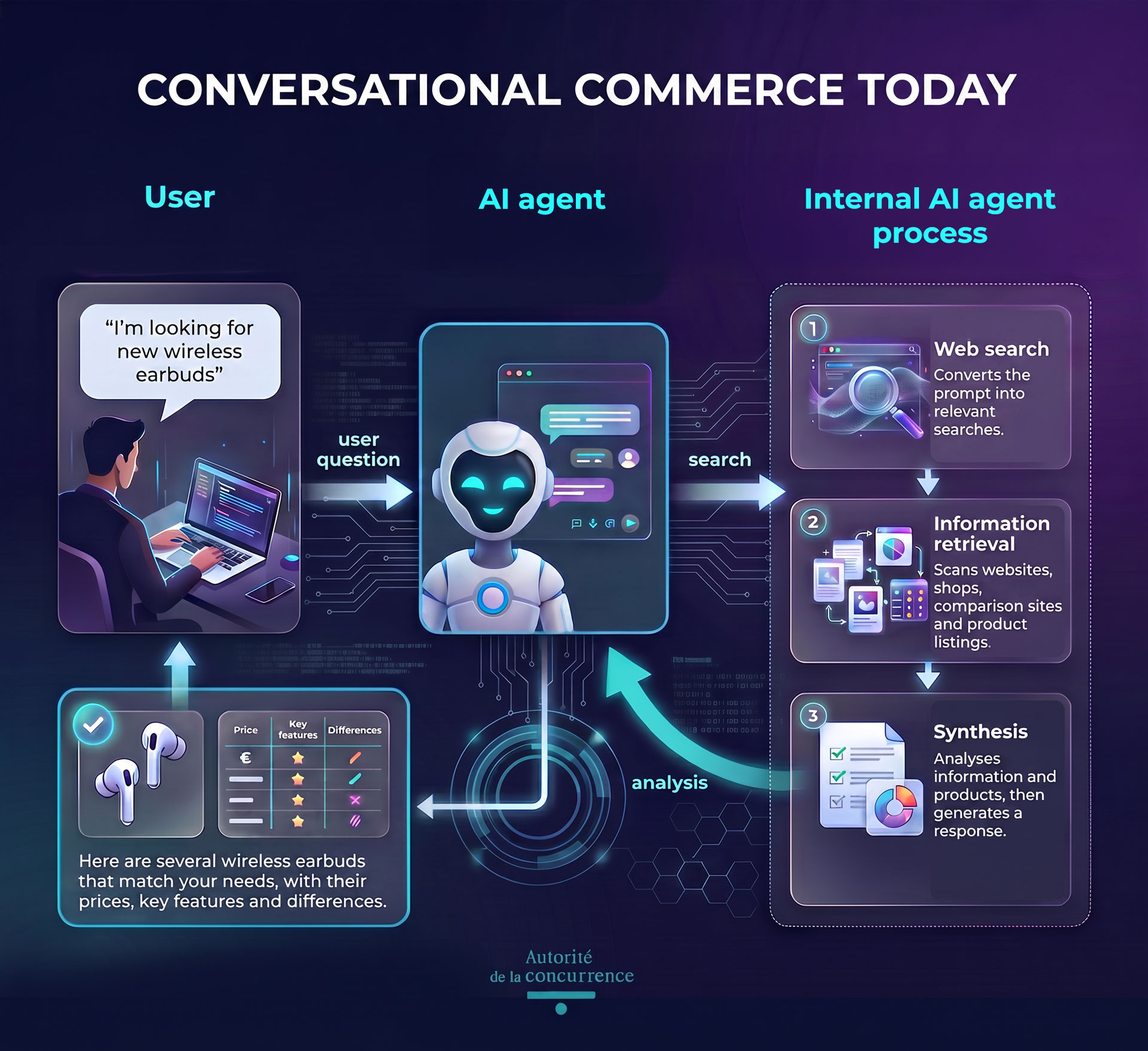
- Agentic commerce, the latest development in agentic AI
Agentic commerce is one of the most recent developments in agentic AI. It refers to the application of AI agents’ capabilities to the e-commerce sector, with the potential, at an advanced stage of development, to fully automate the purchasing journey. In the future, users could purchase a product or service without leaving the AI agent interface. While such services may not yet be available on the French market, users can already search for products and receive recommendations through AI agents.
The existence of barriers to entry and expansion in the AI agents sector
- Lower barriers to entry than for the training of generative models
Compared with the training of generative models, barriers to entry are lower in the AI agents sector. AI agent developers can use models developed by third parties to provide their services. In particular, several cloud computing service providers offer open‑source generative models.
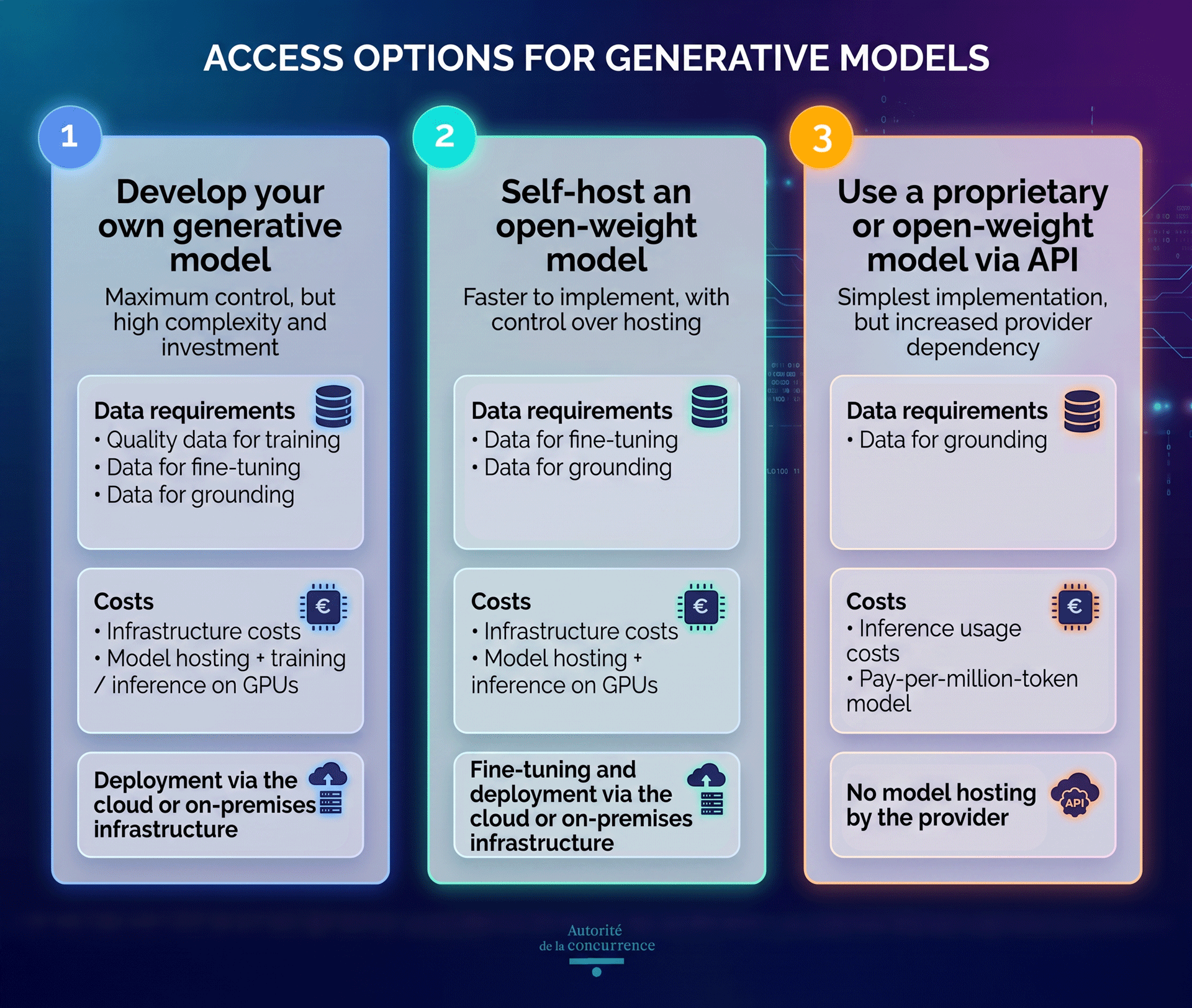
The Autorité nevertheless highlights that AI agent developers using third-party generative models may face specific barriers associated with adapting existing models for specific use cases (for example, in sensitive sectors such as healthcare), as well as contractual and technical dependencies, primarily stemming from their reliance on model providers.
- Higher barriers to expansion than to entry
Access to users
Several large established digital companies benefit from advantages linked to the direct integration of their AI agents into widely used products, including operating systems, browsers, productivity suites, messaging services, app stores and other consumer services (such as search, maps, photos and video). By integrating their AI agents directly into these services or having them pre-installed on mobile phones, these companies gain access to large user bases. By contrast, companies without such integration face significant technological and financial costs to reach users.
Access to data
Vertically integrated companies also have access to vast and constantly expanding proprietary datasets, together with usage data that competitors cannot reasonably replicate. They may enjoy a further advantage when they have access to search engines capable of identifying and ranking relevant data in response to a user prompt. The Autorité notes, however, that the data quality barrier is less significant for specialised AI agents.
Technical, economic and sector-specific barriers
The Autorité also identifies a range of technical and economic barriers. In addition to those relating to migration and interoperability, which may hinder the expansion of AI agents, the Autorité highlights the total cost of inference as a particularly significant challenge. This cost substantially exceeds that of training and increases in proportion to the use of the AI agent. It depends on a number of factors, including the length of the prompt and response, whether the content is text- or video-based, and the size of the model. This cost largely reflects the energy consumption of these different processes and is significantly higher for agentic AI, which requires processing in successive stages.
Agentic commerce is also subject to a number of specific barriers, particularly technological barriers (such as the lack of standardised data or established protocols) and behavioural barriers. This situation favours large companies, which have greater knowledge of user habits and greater financial, economic and human resources to invest in the development of standards. These barriers may be difficult for new entrants to overcome, as they lack access to users’ purchasing histories and detailed behavioural data, while also having to comply with standards they did not help establish.
Competition risks associated with AI agents as new intermediaries in the digital economy
As the performance of generative models becomes increasingly uniform, AI agent developers are placing growing emphasis on the quality of their responses as a key competitive parameter. By integrating an ever-expanding range of services into their interfaces, AI agents are emerging as “platforms”, i.e. intermediaries that are becoming increasingly essential gateways to digital services.
- Disintermediation across parts of the digital economy
The platformisation of AI agents could pave the way for the replacement or disappearance of certain economic operators in the digital economy, as AI agents are able to address a large proportion of user prompts through a single response. While traffic currently redirected directly to e-commerce websites from AI agents remains minimal (less than 5%), it could become a significant channel for reaching consumers by 2030 (between 20% and 25%).
- Disintermediation with risks of discrimination or self-preferencing
Disintermediation may give rise to competition risks for the e-commerce ecosystem. Firstly, it could create a situation in which e-commerce websites become dependent on AI agents. In addition, when purchases are made through an AI agent, e-commerce websites lose access to users’ behavioural data, which could lead to a deterioration in the quality of the service they provide.
Above all, the Autorité highlights the risk of discrimination or self-preferencing in relation to access to digital services, as well as the conditions imposed on e-commerce websites for their content to be made available to users through an AI agent’s interface. Advertising and potential partnerships may also influence the responses provided to users.
- Competition risks associated with control over visibility conditions within AI agent responses
Control over the conditions governing visibility in AI agents’ responses (including the clarity, objectivity and non-discriminatory nature of the visibility criteria applied by AI agents, as well as the number of sources and offers presented to users) could give AI agent developers greater ability to steer consumer demand, particularly in the e‑commerce sector.
- Risks associated with the integration of AI agents into the existing services of vertically integrated companies
Although the integration of AI agents into the existing services of vertically integrated companies may benefit users, the Autorité notes that it also raises significant risks. Several operators could, for example, restrict access to their key services through self‑preferencing, bundling or tying practices, or technical or contractual lock-in mechanisms. The European Commission’s recent interim measures against Meta, aimed at restoring free access to WhatsApp for competing AI assistants, demonstrate competition authorities’ scrutiny of these issues. Looking ahead, vertically integrated companies could be incentivised to alter the commercial terms of their AI agents in ways that could result in exclusionary pricing effects.
Risks associated with the automation of actions by AI agents
AI agents are now capable of anticipating and performing actions on users’ behalf. This capacity for autonomous execution is based on common standards that enable interoperability between digital services and AI services. While the development of standards can have pro-competitive effects, notably by fostering innovation, the Autorité also highlights the risks associated with the centralisation of standards governance in the hands of a limited number of operators, as well as potential barriers to interoperability, all of which create a risk of fragmentation.
To provide their services, AI agents also collect and process ever-increasing volumes of data. This large-scale data processing, combined with the retention of user histories, enables increasingly personalised services but also makes switching from one AI agent to another costly and difficult. These practices could therefore give rise to lock-in effects.
Stakeholders consulted by the Autorité indicated that such risks could result in the sector becoming concentrated around a small number of operators, purchasing processes becoming less transparent, and end consumers being deprived of the ability to make informed choices.
Stakeholders also highlighted to the Autorité the risk of algorithmic collusion. While this risk is not new and has already been examined in a joint study by the Autorité and the Bundeskartellamt (the German competition authority), it could materialise in the agentic commerce sector if AI agents – as their role continues to evolve – were able, in particular, to participate in price negotiations.
Recommendations
The Autorité sets out three sets of recommendations to improve the competitive functioning of the sector and better support users of AI agents.
- Leverage the existing regulatory framework
The rapid deployment of AI agents already calls for close scrutiny by the relevant public authorities. The public consultation found that stakeholders are, on the whole, in favour of maintaining a stable regulatory framework because a substantial body of legislation is already in place (such as competition law, the AI Act, the DMA and rules on anticompetitive practices), and because the time needed to develop new standards is difficult to reconcile with the pace of innovation in the field.
Moreover, closer coordination between the relevant public authorities is needed, given the wide range of issues raised by the development of AI agents (including competition, consumer protection, privacy, financial stability and cybersecurity).
Recommendation 1: The existing regulatory framework should be implemented fully and effectively. While particular innovations may warrant the adoption of specific measures, the Autorité recommends giving priority, in the first instance, to the use of soft law instruments. Any regulatory developments should, in any event, be pursued at European Union level.
Recommendation 2: The Autorité calls for particular vigilance with regard to competition law, specifically concerning:
- equity investments made by major digital companies in competing AI agent developers and partnership agreements between these operators;
- whether users are able, in practice, to choose and use AI agents that compete with those integrated by default into the ecosystems of major digital companies;
- the definition and implementation of the key parameters that may influence how AI agents select, rank or recommend the services proposed by AI agents.
Recommendation 3: The Autorité recommends three priority areas for action to support fair access to AI agent distribution channels for all operators across the sector:
- competition authorities should pay particular attention to the role of AI agent distribution channels, particularly MaaS platforms;
- the European Commission’s work under the Digital Markets Act (DMA) Review and its ongoing market investigations into the cloud computing services sector should continue, building on the Commission’s preliminary position and considering whether marketplaces that distribute AI models should be designated as core platform services;
- if additional companies are designated as such platforms, the Commission should ensure, as part of the ongoing market investigation into whether the obligations currently set out in the DMA are effective in addressing practices that restrict contestability or are unfair in the cloud computing services sector, that AI agent and generative model developers have guaranteed access to such marketplaces and benefit from fair, reasonable and non-discriminatory visibility.
Recommendation 4: A competitive sector depends, in particular, on users being able to compare available offers and make informed choices. This requires:
- greater efforts by public authorities and professionals to improve user awareness and understanding, particularly among younger users;
- proactive engagement by regulators, in particular the Directorate General for Consumer Affairs, Competition and Fraud Prevention (DGCCRF), to ensure the effective enforcement or, where necessary, adaptation of existing regulatory frameworks, particularly those relating to restrictive competition practices, consumer protection law and the Digital Services Act (DSA);
- greater attention from the relevant public authorities, such as the Center of Expertise for Digital Platform Regulation (PEReN), to the technical analysis of AI agents, including through pilot projects, in order to assess the impact of this technological innovation on public policy;
- closer coordination between all the relevant public authorities.
- Promote interoperability and portability in the sector
In its analysis, the Autorité identifies competition risks linked to the limited interoperability of AI agents with the existing services of vertically integrated companies and to barriers to data portability that may prevent users from switching between AI agents.
Recommendation 5: The Autorité urges operators in the sector to establish technical and contractual terms of use that promote interoperability between the services of vertically integrated companies and third-party AI agent developers.
Users should also be able to switch from one AI agent to another without significant loss of information or functionality. This requires, in particular, ensuring effective data portability between AI agents.
- Ensure the development of open standards
Particular attention should be paid to ensuring that standardisation processes do not favour a dominant operator, or a group of operators including dominant companies, which could then impose their own rules and conditions across the sector. Standards should also remain open and interoperable, so that AI agents can access the full range of digital services.
Recommendation 6: The standards governing agentic commerce should be developed and maintained through transparent, open and collaborative processes, in order to prevent any situation in which a dominant operator exercises excessive control or influence. These standards should also ensure the highest possible level of openness consistent with security and reliability requirements, in particular through the adoption of open-source solutions and fully interoperable standards.
The Autorité does not prejudge any future antitrust assessment or enforcement action in relation to the matters examined in this opinion. Nevertheless, the competition risks identified in this opinion will continue to be closely monitored by the Autorité and its teams.
Opinion 26-A-05 of 17 July 2026
Contact(s)